
Table of Contents
For aspiring teachers, passing the Licensure Examination for Teachers (LET) is their ultimate goal to obtain a license and be called Licensed Professional Teachers (LPT).
However, like other professional examinations, passing the LET is not easy.
That is why thorough and proper preparation is necessary if you want to ace the LET.
Unfortunately, not all teachers have the privilege to enroll in review centers.
In this post, we discuss tips to pass the LET without enrolling in a review center.
Throughout this article, we will tackle the following:
- What is LET?
- What are the requirements?
- Who is eligible to take the LET?
- What is the passing score?
- What is the coverage of the exam?
- How to pass the LET successfully?
Learning the answers to these questions will help you fully understand how the LET is conducted.
What is LET?
LET stands for the Licensure Examination for Teachers.
It is a professional examination promulgated by the Professional Regulation Commission (PRC) and the Board for Professional Teachers (BPT).
According to Republic Act 7836, also known as the Philippine Teachers Professionalization Act of 1994, passing the Licensure Examination for Teachers is a legal requirement before one can teach in the Philippines.
Although this is a universal requirement, several exemptions allow individuals to teach without a license under specific conditions.
1. Incumbents (before the RA 7836)
These are individuals who were automatically granted a license to teach even without taking the LET before the enactment of Republic Act 7836 on December 16, 1994, as long as they had PD 1006 eligibility or Civil Service Commission teacher eligibility.
2. Special Permits for Experts
Under Republic Act 7836, Section 26, as amended by Republic Act 9293, the law allows any non-licensed individual who is internationally recognized as an expert in their field to teach by granting them a special or temporary permit.
For example, Lea Salonga can teach music as she is internationally recognized as an expert in music and performing arts.
This recognition makes her eligible for a special permit to teach Music even without a professional teacher’s license.
3. Para-teachers
These are non-passer teachers who took the LET, but their general average falls from 70 to 74.
Individuals with a rating not lower than 5 percentage points from the passing general average of 75% (a rating of 70 to 74%), according to the RA 7836, are eligible to teach with a 2-year special permit, renewable for a non-extendible period of two (2) years.
4. K-12 Senior High School Specialized Practitioners
These are individuals who were granted a special permit to teach due to their specialization in specialized or technical courses, such as accountants, IT professionals, engineers, and other experts in Technical-Vocational tracks.
According to Section 8 of Republic Act 10533, these individuals are granted 5 years from the date of hiring to take and pass the LET.
What are the requirements for LET?
Before taking the LET, you need to prepare the following documents:
1. Original and photocopy of your Transcript of Records (TOR) with a scanned photo and with the exact remark of “For Board Examination Purposes Only.”
2. Original and photocopy of your PSA Birth Certificate.
3. Original and photocopy of your PSA Marriage Contract (applicable for married females only)
4. Passport-sized photos with a white background (bring both passport-sized photos with or without a nametag, as some branches look for with or without a nametag)
5. Valid Identity Card, such as a postal ID, National ID, etc. (if no valid ID, in some branches, they accept a cedula or Community Tax Certificate as proof of identity)
6. Documentary stamp
7. Printed Payment Receipt of 900 Pesos
How to apply for LET?
Once you have gathered the basic requirements, you need to create a LERIS (Licensure Examination & Registration Information System) account for the online application.
Step 1: Open the link https://online.prc.gov.ph/ to create your LERIS account.
Step 2: Click “REGISTER”, scroll down, and tap “I AGREE”
Step 3: Fill out the details with honesty.
Step 4: Check your email to confirm or verify your registration.
Step 5. Once done, log in, complete your personal profile, and upload your 2×2 ID photo with a white background.
Step 6. After filling out the necessary details, follow the steps below:
Tap SELECT TRANSACTION, choose the Examination tab, and enter the transaction details such as:
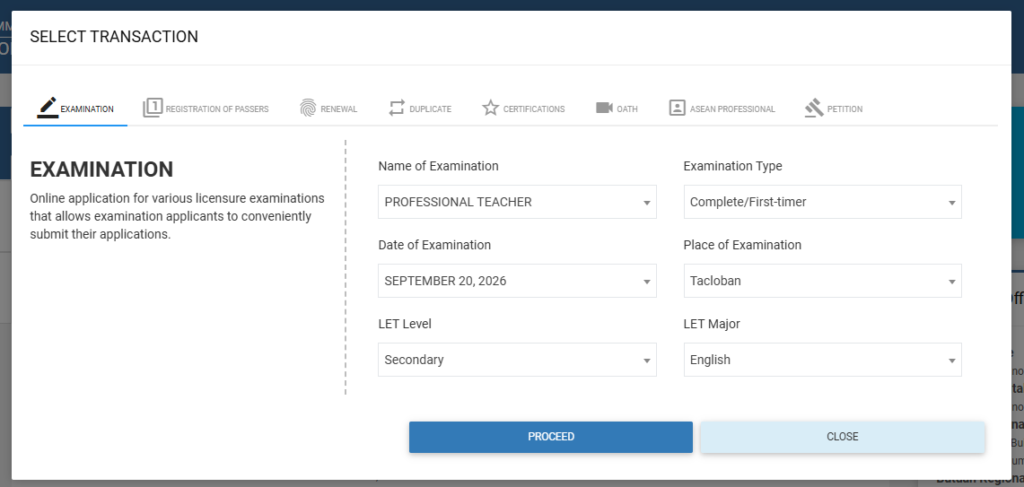
Name of Examination: Professional Teacher
Examination Type: Complete/First-timer (or Repeater)
Date of Examination: Choose the targeted exam date
Place of Examination: Choose the preferred testing region
LET Level: Elementary/Secondary
LET Major: Select your major.
After completing the details, click Proceed for Appointment.
Step 7: Review the auto-generated PRC Appointment details. Select your preferred PRC Regional Office or satellite desk, then pick an available date and time slot for your face-to-face document verification.
Step 8: Click Proceed to Payment and select your preferred payment channel to settle the ₱900 processing fee:
GCash / Maya: Instant mobile wallet settlement via the Paynamics gateway.
LandBank Link.BizPortal: For online retail banking or over-the-counter payments.
Step 9: Go back to your LERIS account dashboard, then select Existing Transactions. Download and print your official PRC Application Form and payment receipt.
Step 10: On your scheduled appointment date, present the printed form and receipt to your chosen PRC Regional Office along with your original and photocopied supporting documents for final validation.
Who is eligible to take the LET?
To take the LET, make sure to meet the following eligibility requirements as stated in RA 7836, Section 15.
To qualify, applicants must be:
(a) Filipino citizens or aliens whose country has reciprocity with the Philippines in the practice of the teaching profession,
(b) At least eighteen (18) years of age;
(c) In good health and of good reputation with high moral values;
(d) Has not been convicted by final judgment by a court for an offense involving moral turpitude
(e) A graduate of a school, college, or university recognized by the government and possessing the minimum educational qualifications, as follows:
1. For Elementary Education, all applicants (first-timers or repeaters) must have a bachelor’s degree in Elementary Education
2. For Secondary Education, all applicants (first-timers or repeaters) must have a bachelor’s degree in Secondary Education with a major in any of the following:
| Area | Specializations Available |
|---|---|
| Traditional Majors | English, Filipino, Mathematics, Science, Social Studies, Values Education |
| Technical Fields | Technology and Livelihood Education (TLE), Information and Communication Technology (ICT) |
| Specialized Tracks | Physical Education, Bachelor of Special Needs Education (BSNEd), Music, Arts, Physical Education, and Health (MAPEH) |
3. For non-education graduates, you must have at least eighteen (18) units in Professional Education, such as the following:
| Core Subjects (12 Units) | Elective/Specialization (6 Units) |
|---|---|
| Foundation of Education/Teaching Profession (3 units) Child and Adolescent Development (3 units) Principles and Methods of Teaching (3 units) Assessment in Learning (3 units) | Any 2 of the following subjects: The Teacher and the School Curriculum (3 units) Curriculum Development (3 units) Educational Technology (EdTech) (3 units) Principles of Guidance and Counseling (3 units) |
What is the coverage of the LET?
If you are serious about your LET preparation, knowing the scope or coverage is important so that you will know what to prepare and study.
In this section, we will discuss the coverage in General Education and Professional Education based on the latest Table of Specifications for Teachers.
Coverage in General Education and Professional Education for both Elementary and Secondary Examinations.
| Core Subjects in General Education | Difficulty Level based on Bloom’s Taxonomy |
|---|---|
| Intellectual Competencies Total Weight: 40% or a total of 60 Questions 1. Purposive Communication in English 2. Malayuning Komunikasyon sa Wikang Filipino 3. Science and Technology 4. Mathematics | Easy: 30% Remember: 9 Understand: 7 Moderate: 50% Apply: 30 Difficult: 20% Analyze: 6 Evaluate: 4 Create: 4 |
| Personal and Civic Responsibilities Total Weight: 30% or a total of 45 Questions 1. Readings in Philippine History and Society 2. The Life and Works of Jose Rizal 3. Ethics | Easy: 30% Remember: 7 Understand: 7 Moderate: 50% Apply: 22 Difficult: 20% Analyze: 5 Evaluate: 2 Create: 2 |
| Practical Skills Development Total Weight: 30% or a total of 45 Questions 1. The Contemporary World 2. Art Appreciation 3. Understanding the Self | Easy: 30% Remember: 8 Understand: 7 Moderate: 50% Apply: 23 Difficult: 20% Analyze: 4 Evaluate: 2 Create: 1 |
| Core Subjects in Professional Education | Difficulty Level based on Bloom’s Taxonomy |
|---|---|
| Teaching Professions Total Weight: 15% or a total of 23 Questions 1. Foundation of the Teaching Learning Process 2. The Professional Teacher | Easy: 15% Remember: 3 Understand: 3 Moderate: 50% Apply: 12 Difficult: 20% Analyze: 3 Evaluate: 1 Create: 1 |
| The Teacher and the School Curriculum, Methods and Strategies of Teaching, Educational Technology for Teaching and Learning Total Weight: 30% or a total of 45 Questions 1. The Teacher and the School Curriculum 2. Methods and Strategies of Teaching 3. Educational Technology | Easy: 30% Remember: 6 Understand: 6 Moderate: 50% Apply: 25 Difficult: 20% Analyze: 4 Evaluate: 2 Create: 2 |
| The Child and Adolescent Learners and Learning Principles Total Weight: 20% or a total of 30 Questions 1. Headstart for Toddlers, Children, and Adolescents | Easy: 20% Remember: 5 Understand: 5 Moderate: 50% Apply: 15 Difficult: 20% Analyze: 3 Evaluate: 1 Create: 1 |
| Assessment of Learning Total Weight: 15% or a total of 22 Questions 1. Validating theoretical knowledge in the actual assessment of learning | Easy: 20% Remember: 3 Understand: 3 Moderate: 50% Apply: 12 Difficult: 20% Analyze: 2 Evaluate: 1 Create: 1 |
| Field Study and Teaching Internship Total Weight: 20% or a total of 30 Questions 1. Documentation of Experiential Learning | Easy: 20% Remember: 5 Understand: 5 Moderate: 50% Apply: 15 Difficult: 20% Analyze: 3 Evaluate: 1 Create: 1 |
What is the passing score for LET?
To pass the Licensure Examination for Teachers, according to the PRC BOARD FOR PROFESSIONAL TEACHERS RESOLUTION NO. 228, SERIES OF 1996, October 23, 1996, all examinees must obtain a rating of 75% with no rating lower than 50% in either General Education, Professional Education, or Specialization.
This means that even if you obtain a rating of 75% or more, if one of your ratings in General Education, Professional Education, or Specialization is below 50%, your remark is FAILED.
Here’s how your LET scores are computed.
| Elementary Education | Secondary Education and BEED with Specialization |
|---|---|
| General Education – 40% | General Education – 20% |
| Professional Education – 60% | Professional Education – 40% |
| Major/Specialization – 40% | |
| Total: 100% | Total: 100% |
Formula:
1. To get your percentage rating: Subtest Percentage = Scores/Raw Scores x 100
2. To get your weighted average: Weighted Score = Subtest Percentage x Weighted Average
For example, in General Education, you scored 135/150, in Professional Education, 128/150, and in Specialization, 110/150.
General Education:
Subtest Percentage = 135/150 = 0.9 x 100 = 90% (This is your rating in General Education)
Weighted Score = 90 x 20% = 18% (This is your weighted score in General Education)
Professional Education:
Subtest Percentage = 128/150 = 0.853 x 100 = 85.3%
Weighted Score = 85.3 x 40% = 34.12%
Specialization:
Subtest Percentage = 110/150 = 0.733 x 100 = 73.3%
Weighted Score = 73.3 x 40% = 29.32%
| Core Subjects | |
|---|---|
| General Education | 18% |
| Professional Education | 34.12% |
| Specialization | 29.32% |
| TOTAL: | 81.44% (Your LET final rating) |
NOTE: For BEED, use the same formula.
However, what if you meet a passing average of 75, yet you obtained a score below 50% in any of the core subjects? Will you pass?
Well, take a look at the following examples.
Example #1 (For BEED and BSED with Specialization)
| Core Subjects | Score | Weighted Score |
|---|---|---|
| General Education | 143/150 x 100 = 95.3% | 95.3 x 20% = 19.06% |
| Professional Education | 138/150 x 100 = 92% | 92 x 40% = 36.8% |
| Major/Specialization | 74/150 x 100 = 49.3% | 49.3 x 40% = 19.72% |
| Total | 75.58% | |
| Remarks | FAILED |
In this example, Teacher A obtained a general rating of 75.58.
However, her remark is FAILED because, according to the Board for Professional Teachers, she obtained a rating of below 50 in her specialization.
Therefore, even if you meet the passing grade, if you have below 50% in any of the core subjects, your remark still FAILED.
Example #2 (For BEED with no S
| Core Subjects | Score | Weighted Average |
|---|---|---|
| General Education | 74/150 x 100 = 49.3% | 49.3 x 40% = 19.72% |
| Professional Education | 145/150 x 100 = 96.6% | 96.6 x 60% = 57.96% |
| Total | 77.68% | |
| Remarks | FAILED |
In Example #2, Teacher A obtained a general rating of 77.68%.
However, according to the guidelines, she is not qualified to pass the exam because she obtained a rating of 49.3 in General Education.
Example #3
| Core Subjects | Score | Weighted Average |
|---|---|---|
| General Education | 143/150 x 100 = 95.3% | 95.3 x 20% = 19.06% |
| Professional Education | 138/150 x 100 = 92% | 92 x 40% = 36.8% |
| Major/Specialization | 75/150 x 100 = 50% | 50x 40% = 20% |
| Total | 75.86% | |
| Remarks | PASSED |
| Core Subjects | Score | Weighted Average |
|---|---|---|
| General Education | 75/150 x 100 = 50% | 50 x 40% = 20% |
| Professional Education | 140/150 x 100 = 93.3% | 96.6 x 60% = 55.98% |
| Total | 75.98% | |
| Remarks | PASSED |
As you can see, in both scores, they received a PASSED remark because, aside from meeting the general rating of 75, they have no subject scores below 50%.
So, if you want to pass the LET, ensure you get a rating of 75% or more with no rating below 50 in any subject.
Free 2000+ LET Questions and Answers
Free LET Reviewer 2026
Challenge your knowledge! Answer exciting questions across various categories.
Quiz Rules & Guidelines:
- 1. You have Lifelines available to use once per quiz test.
- 2. You can use Manual Elimination where you choose which options to remove. (Warning: You can accidentally eliminate the correct answer!)
- 3. You have a Pooled Timer matching 60 seconds per question (e.g., 10 questions = 10 minutes total) to manage your time flexibly.
- 4. You must score at least 80% correct answers to pass and unlock the next test level.
Welcome back, User!
Choose a category to start the quiz.
Category Title
Select Your Test Level
Loading question…
“I think the answer is…”
Explanation:
The explanation of the correct choice will appear here.
Quiz Results
Here is the detailed summary of your quiz performance.
Congratulations, User!
You earned enough points to pass this test level!
Question Review
What color is the sky?
…
Message
Detailed notification details.